
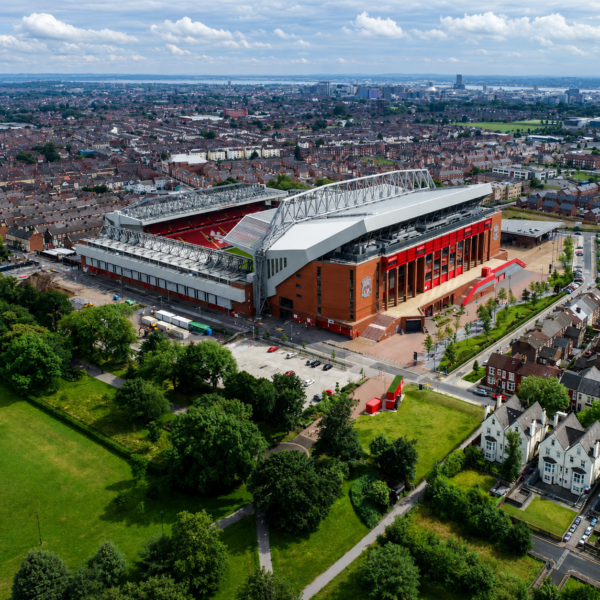
There is a moment on a Liverpool matchday when Anfield seems to expand beyond the stadium itself.
Long before the players emerge from the tunnel, the surrounding streets begin to change. Scarves appear. Familiar songs can be heard among the crowds. Friends search for their usual meeting points. Supporters who have followed Liverpool for generations share the same pavements with visitors who have travelled thousands of miles to see Anfield for the first time.
By kick-off, around 60,000 supporters will be inside the stadium.
But the Liverpool matchday has already been underway for hours.
That distinction matters, because Liverpool Football Club’s identity has never existed solely within the boundaries of a football ground. The neighbourhood surrounding Anfield has played its own part in the club’s story.
Walton Breck Road, Anfield Road, the surviving Victorian buildings, the statues and memorials, and generations of local businesses have collectively created something that cannot simply be reproduced by constructing a modern stadium.
They have given Liverpool a sense of place.
And remarkably, that connection stretches all the way back to the club’s birth.
Before Liverpool FC existed
The strangest part of Liverpool’s origin story is that Anfield existed before Liverpool Football Club did.
Everton began playing at Anfield in 1884 and remained there for several years. The club won its first league championship while based at the ground in the 1890–91 season.
But the relationship between Everton’s committee and Anfield’s owner, John Houlding, deteriorated.
The disagreement eventually resulted in Everton leaving Anfield and moving to nearby Mere Green Field, which became Goodison Park.
Houlding was left with a football ground, but no team to play in it.
His response changed the sporting history of the city.
In 1892, Liverpool Football Club was formed.
That means the neighbourhood around today’s Anfield is not simply where Liverpool later became successful. It is where the club itself emerged.
More than 130 years later, supporters still approach the same part of the city to watch a team whose creation was inseparable from the ground beneath their feet.
That gives Liverpool an unusually direct relationship between stadium, neighbourhood and origin.
The Sandon and the beginning of the story
One building in particular provides a tangible connection with those early years: The Sandon.
Its significance is historical rather than simply geographical.
John Houlding had The Sandon built in 1870, and Everton later held meetings there during the years before the split that led to Liverpool FC’s creation. The pub and its bowls pavilion were also closely connected with the club’s early footballing life.
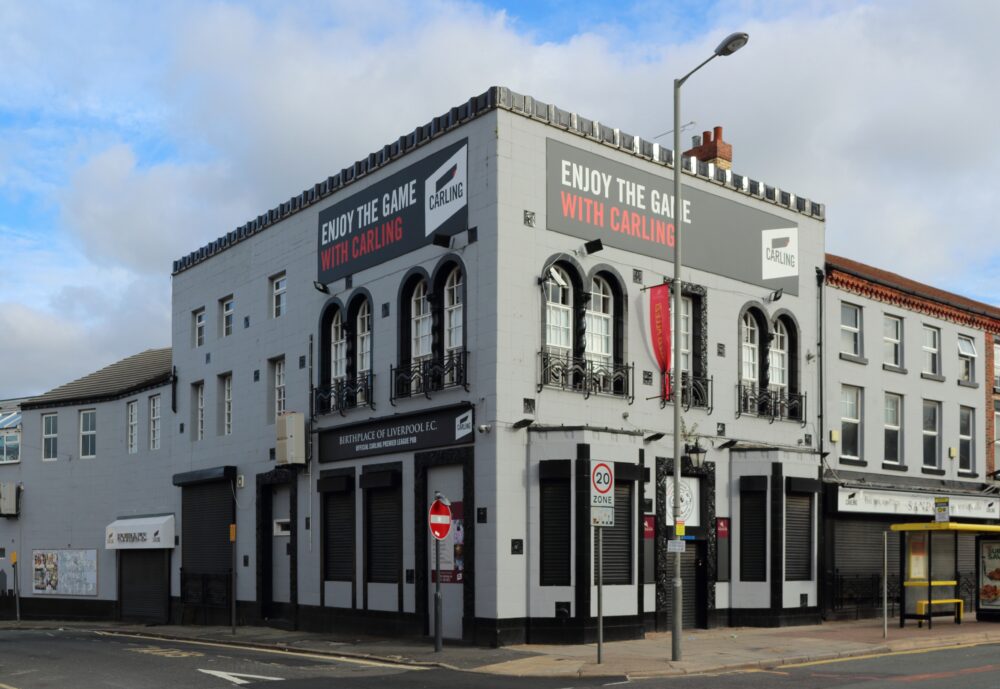
That gives the building an extraordinary place in the history of Merseyside football.
Liverpool supporters today know a club of European Cups, league championships, iconic managers and players recognised around the world.
None of that existed in 1892.
There was no Kop mythology. No Shankly. No Paisley. No Istanbul. No famous all-red Liverpool strip.
There was simply a new football club trying to establish itself.
The fact that buildings associated with that period remain part of the modern matchday landscape provides a direct connection between two completely different versions of Liverpool FC.
One belongs to Victorian football.
The other belongs to a global sporting institution.
Yet geographically, remarkably little separates them.
Walton Breck Road: Liverpool’s matchday corridor
For many supporters, Walton Breck Road is where the anticipation becomes real.
Anfield suddenly dominates the surroundings.
The Kop rises alongside the road, supporters converge from different directions and the density of red increases as kick-off approaches.
But the road is more than an approach to a stadium.
Over generations it has become part of the ritual of attending Liverpool matches.
Football supporters are creatures of habit.
They use familiar routes. They arrange familiar meeting points. Families repeat routines established years earlier. Certain corners become associated with memories of particular matches, seasons and people.
Those traditions are rarely recorded in official club histories.
Yet they are one of the ways football culture passes between generations.
A stadium can be renovated almost completely while those routines continue outside it.
Anfield demonstrates this particularly well.
The ground has changed dramatically during Liverpool’s history. Terraces disappeared. Stands were rebuilt. The Main Stand was transformed. More recently, the redevelopment of the Anfield Road Stand significantly increased capacity.
A supporter approaching the stadium decades ago would recognise much about the location but relatively little about the physical structure they eventually entered.
The streets therefore provide continuity.
They connect different versions of Anfield.
The Kop’s influence begins outside
The Kop is one of football’s most famous stands, but its cultural influence does not stop at the turnstiles.
Songs associated with Liverpool can often form part of the build-up around the stadium before they are heard inside it.
That helps explain something important about Anfield’s reputation for atmosphere.
The noise inside the stadium does not simply appear when the referee starts the match.
Emotion has been accumulating beforehand.
Supporters have been discussing the team.
They have been meeting friends.
They have been remembering previous matches.
They have been predicting what is about to happen, usually with varying degrees of optimism.
By the time supporters enter the ground, the emotional temperature has already risen.
The stadium concentrates that energy.
It does not create all of it from nothing.
That is why experiencing only the ninety minutes can reveal only part of what makes an Anfield matchday distinctive.
The meeting places around Anfield
That build-up has traditionally had its own meeting places, and the pubs surrounding Anfield are an important part of the story.
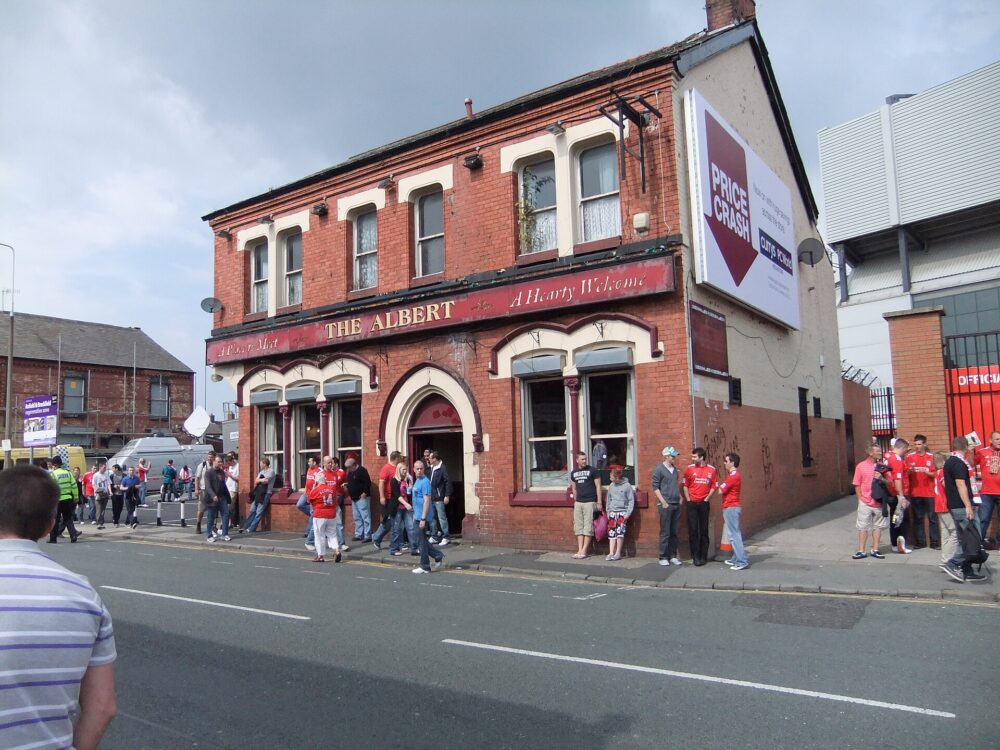
The Sandon carries the deepest historical connection, with its links to John Houlding and the events surrounding the birth of Liverpool FC. But on a modern matchday it sits alongside other familiar names such as The Albert, The Park and Arkles, each occupying its own place in the geography of an Anfield afternoon.
The Albert and The Park, close to the Kop end of the stadium, have become familiar gathering points as the crowds build before kick-off.


Arkles, on Anfield Road, has developed a somewhat different matchday identity and has traditionally been associated with visiting supporters as well as football crowds more generally.
These places are significant not because they form a checklist for visitors, but because they demonstrate how the matchday atmosphere develops beyond the stadium itself.
Hours before the teams emerge, supporters are already meeting, talking about the side, remembering previous matches and anticipating what might happen next.
Songs and conversations spill back onto the surrounding streets as kick-off approaches.
Eventually those separate gatherings become one crowd moving towards the turnstiles.
In that sense, the pubs around Anfield do not merely sit beside Liverpool’s matchday culture; they have helped provide some of its traditional meeting places across generations.
A neighbourhood carrying football history
Look closely around Anfield and Liverpool’s history appears in layers.
There are reminders of managers who shaped the club.
There are tributes to players.
There are memorials representing events far more important than football results.
There are buildings that predate Liverpool FC itself.
And increasingly, murals have turned walls around the neighbourhood into informal pieces of football storytelling.
The murals that turn streets into a gallery
In recent years, that storytelling has become particularly visible through the Liverpool murals that have appeared on houses and buildings around Anfield.
Portraits celebrating some of the club’s best-known players and managers have transformed otherwise ordinary walls into landmarks that supporters actively seek out as they walk towards the stadium.
They represent a relatively new addition to a neighbourhood filled with much older football history, yet they perform a familiar role.
They connect people, places and Liverpool memories.
For supporters travelling from overseas in particular, finding the murals has become part of exploring Anfield, with photographs taken beside them providing a physical reminder of a journey that may have been planned for years.
There is something fitting about Liverpool’s heroes appearing on the walls of the neighbourhood rather than only inside the stadium.
The images bring the club’s history into the streets and reinforce the sense that Anfield’s identity cannot be contained by the stadium boundary.
Victorian buildings, traditional meeting places, memorials, statues and modern murals now sit within the same landscape, each representing a different chapter of Liverpool’s relationship with the area.
This creates an unusual relationship between club history and physical space.
Football history is often encountered inside museums.
At Anfield, parts of it surround you before you enter.
That comes with responsibility too.
Anfield is not a football theme park.
It remains part of a real community in north Liverpool.
For supporters arriving from elsewhere, particularly those making their first visit, recognising that distinction matters.
People live here.
Businesses operate here throughout the year.
Families have watched the stadium and the club change around them.
The matchday visitor temporarily joins that environment rather than owning it.
Respect for the neighbourhood is therefore part of respecting the club itself.
From local institution to global destination
Perhaps nothing illustrates Liverpool’s transformation more clearly than the distances supporters now travel to reach Anfield.
Liverpool has had support outside the city for generations, but modern football has taken that relationship to another level.
On any given matchday, supporters may arrive from Ireland, Scandinavia, North America, Asia, Australia, elsewhere in Britain and countless other places.
For some, visiting Anfield is the culmination of years of supporting Liverpool from afar.
They know the stadium from television.
They know the songs.
They recognise famous entrances and landmarks before ever seeing them in person.
Then, for the first time, those images become physical places.
This creates an intriguing contrast.
Anfield is simultaneously intensely local and unmistakably global.
The club belongs to a particular part of Liverpool, yet its emotional reach extends around the world.
On matchday those identities meet in the streets surrounding the stadium.
A supporter who has walked to Anfield hundreds of times may pass someone who has spent years saving for one visit.
Both are heading towards the same turnstiles.
That is one of modern Liverpool FC’s defining characteristics.
The places between the famous places
Visitors naturally gravitate towards the landmarks they recognise.
The Shankly statue.
The Paisley statue.
The Kop.
The memorials.
The stadium itself.
But some of the strongest football culture exists between those landmarks.
It exists in ordinary routines.
In the places supporters agree to meet.
In conversations outside the ground.
In the walk towards the stadium.
In a parent showing a child a place associated with their own first match.
These moments rarely appear in statistics or trophy lists, but they explain why football clubs can become inherited identities rather than simply teams people choose to watch.
Liverpool’s history is filled with extraordinary personalities and extraordinary matches.
Yet its culture has also been built through millions of completely ordinary matchdays.
Supporters arrived.
They met.
They walked towards Anfield.
They watched Liverpool.
Then they did it again.
Decade after decade, those repetitions became tradition.
Anfield changes, rituals survive
Modern Anfield would astonish many supporters from previous generations.
The stadium is larger, more sophisticated and far more commercially developed.
Tickets work differently.
Media coverage is unrecognisable.
Supporters can follow every development involving Liverpool instantly from anywhere in the world.
The football business surrounding the club has transformed.
Yet on matchday, certain fundamentals remain remarkably resistant to change.
People still arrange where to meet.
They still debate the team before seeing the starting XI.
They still walk towards the stadium with a mixture of expectation and nerves.
Children still attend their first Liverpool match alongside relatives who remember their own.
And when the opening notes of You’ll Never Walk Alone arrive before kick-off, generations separated by decades participate in the same ritual.
That continuity is valuable precisely because so much else has changed.
More than a stadium
Anfield deserves its reputation as one of football’s great grounds.
But perhaps the mistake is thinking of Anfield purely as a building.
Its identity extends into the surrounding streets, landmarks, businesses and community.
It exists in places connected to the club’s Victorian beginnings and in newer expressions of supporter culture.
It exists in the routes generations have taken towards the ground.
And it exists in the strange transformation that happens around the neighbourhood whenever Liverpool are at home.
Hours before kick-off, thousands begin moving towards the same small area of the city.
The streets grow louder.
The stadium draws closer.
Conversations increasingly turn towards the match.
Eventually, the crowds disappear through the turnstiles.
Then Anfield takes over.
But the famous atmosphere inside the stadium has a history before the teams emerge.
Part of it has been building outside.
And that may be the best way to understand why Anfield remains different.
Liverpool’s matchday culture was never built by concrete and steel alone.
It was built by people, places, memories and routines repeated across generations.
The stadium is its heart.
But the story has always extended beyond the turnstiles.