
Editor’s note: In this follow-up to his recent opinion piece on Mohamed Salah’s departure, Theo Dorus expands the argument to Liverpool’s wider post-Klopp direction.
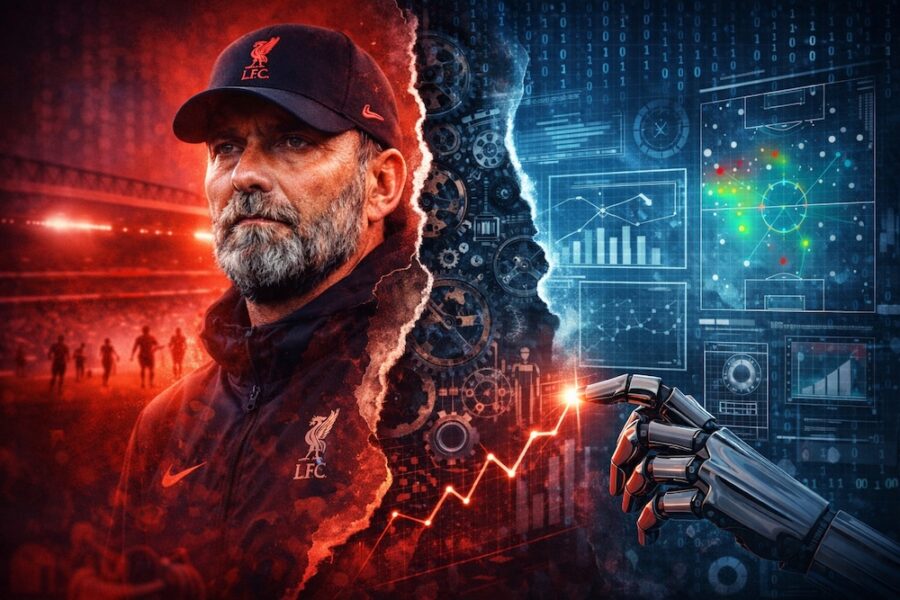
Liverpool’s data department should be the envy of football. It is staffed by physicists, mathematicians and astronomers, because the skills needed to build statistical models and predict outcomes from complex data are much the same whether tracking subatomic particles or football players.
Dr Ian Graham, a Cambridge physicist, led the department from 2018 to 2022 and helped identify players who would define an era. When Graham left, Dr Will Spearman, a physics PhD from Harvard, took over as director of research. In April 2025, with Liverpool still chasing trophies, Michael Edwards and FSG pulled off what the Liverpool Echo called a major coup by hiring Laurie Shaw from the City Football Group as the club’s new chief scientist.
This is not an ordinary recruitment department. It is a scientific laboratory.
That department’s faith in data reportedly played a huge part in identifying Arne Slot as Jürgen Klopp’s successor. The model judged him the best fit for the squad Klopp left behind. But the team he inherited is already beginning to feel like a distant memory.
The same structure that once helped Liverpool find Salah, Robertson and Firmino now appears increasingly willing to let prime players drift, sell academy graduates and leave the next generation on the margins.
Klopp’s gift
One of Klopp’s greatest strengths was man-management. He improved players, but he also gave them belief. He took young footballers such as Trent Alexander-Arnold, Harvey Elliott and Jarrell Quansah and gave them a route into the first team. He did not simply assess them for what they were. He trusted what they might become.
That is the human element data can never fully measure. A model can project performance, but it cannot quantify what happens when a manager sees something in a player, believes in him and creates the conditions for him to grow.
Slot does not look like the same kind of developer of young talent. That does not make him a poor coach, but it does make him a very different one. Under Klopp, Liverpool often felt like a place where young players could emerge and mature. Under Slot, the pathway looks narrower, the opportunities fewer and the margins for error smaller.
That matters, because a club’s academy is not just a talent pool. It is one of the places where identity is formed.
It is difficult to know if we have seen the real Slot in action. It may be that Slot is operating within a wider structure above him, and that the role of head coach is merely one process within the system.
Klopp’s tactical direction was clearly his own interpretation of how the game should be played. Gegenpress was his style long before he joined Liverpool. His imprint on the team and city defined a man who was in control.
Slot does not appear to be in control. But it should also be noted how incredibly difficult it would be to manage an entire team who had just lost Jota, a close friend of many years.
The academy exodus
Trent Alexander-Arnold joined Liverpool at six, came through the academy, won the Champions League and the Premier League, and left in the summer of 2025 as the end of his contract approached.
Jarell Quansah joined at five, emerged as a first-team centre-back under Klopp, then after one difficult season under Slot was sold to Bayer Leverkusen for £35 million. Since that move, he has established himself as a key player and earned a senior England debut.
Harvey Elliott, signed from Fulham at 16 and later Player of the Tournament at the Under-21 Euros after scoring six goals, found starts increasingly hard to come by and was moved on to Aston Villa in a deal that may yet become permanent for around £35 million.
Tyler Morton was sold for £15 million, despite just helping England win the Under-21 Euros the same summer.
None of these departures, taken in isolation, would prove anything. Clubs sell players. Managers make choices. Pathways close. But taken together, they suggest something more troubling: Liverpool no longer look fully committed to developing and keeping their own.
These were not just squad players or assets on a spreadsheet. They were part of the club’s continuity. Their exits feel less like natural evolution and more like a system allowing its own to slip away too quickly.
The prime asset they cannot afford to lose
Then there is Ibrahima Konaté.
He is 26, a France international, a Champions League winner and a Premier League winner. He is in his prime. Yet his contract continues to drift towards its end without resolution. If nothing changes, Liverpool risk losing another elite player for nothing.
That should worry supporters. It should also reflect badly on the club’s leadership.
Konaté has reportedly been frustrated by the structure of Liverpool’s offer, with suggestions that performance-based incentives form a major part of the package. Whether that proves decisive or not, the broader picture is hard to ignore. Liverpool have already allowed Trent Alexander-Arnold to run down his deal. If Konaté follows him out, it will look like more than bad luck. It will look like a pattern.
Players notice these things. They notice when contract situations drift. They notice when replacements are lined up before renewals are settled. They notice when the club appears more comfortable modelling scenarios than closing the deal in front of it.
For Richard Hughes, Liverpool’s sporting director, losing two elite players in successive years under those circumstances would be a serious indictment.
The heart the data cannot replace
The issue is not data itself. Liverpool’s data-led structure has been one of the smartest in football and has played a major role in the club’s modern success. The problem is what happens when data stops being one tool among many and becomes the dominant logic of the club.
A system that once helped uncover talent now seems increasingly comfortable discarding it. The same club that built one of Europe’s most admired sides through smart recruitment, strong coaching and careful development now feels more transactional. Quansah becomes a saleable asset. Elliott becomes expendable. Trent drifts away. Konaté hangs in limbo. Salah no longer fits. Piece by piece, something is being stripped out.
What Klopp built was never just quality. It was connection. It was belief. It was the sense that Liverpool were more than the sum of their parts.
That was not generated by an algorithm.
It came from a manager who improved players, trusted young talent and made individuals feel part of something bigger. Liverpool did not only have a great team under Klopp. They had a team with emotional coherence. It played with edge, desire and conviction.
That sense of collective purpose is what now feels diminished.
After losing only one of 34 games before winning the league last season, Liverpool have since gone on to lose 13 of their next 35. Numbers alone never tell the whole story, but in this case they support what the eye already suggests: something fundamental has shifted.
The loss of that collective heart, and the surrender of the club’s soul to spreadsheet-driven decisions, are now being reflected in poor performances. The team no longer has the same intensity. They look less connected between the lines. And they have become slower at reacting to setbacks. Whether that can be rebuilt under Slot, or whether the system has permanently changed what this team is, may take more than one season to answer.
Liverpool’s machine has not stopped working. That is precisely the problem. It is still working, but it increasingly appears to be tearing out the very heart of Klopp’s team.