

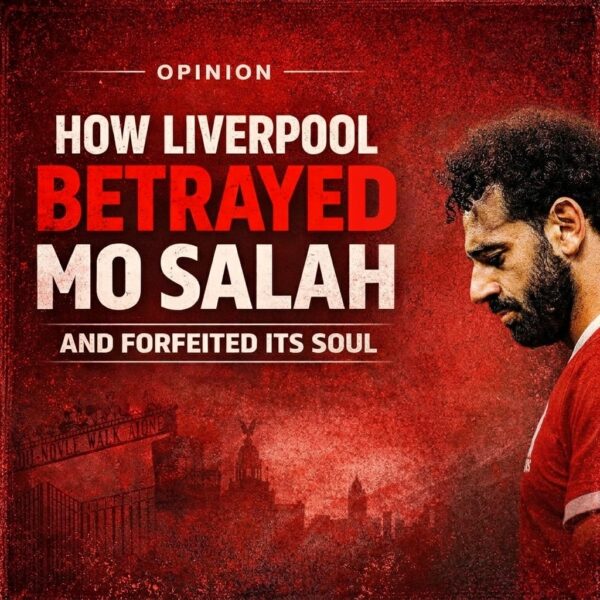
Almost two years on from Jurgen Klopp’s departure, we may be witnessing the failure of a data-driven moneyball system, and Klopp himself may have foreshadowed it as far back as the 2021-22 Premier League season.
On March 24, the ‘Egyptian King’, as our adoring fans call him, announced he was leaving Liverpool Football Club. Mohamed Salah will play his last game for the club this season, a year earlier than the deal he fought so hard to obtain.
In a heartfelt address to fans, Salah said: “Leaving is never easy. You gave me the best time of my life. I will always be one of you. This club will always be my home. Because of all of you, I will never walk alone.”
It is hard to believe this is how he imagined his departure. It was never meant to be this way. This feels like an abdication. It was supposed to be a regal send-off to the riches of Saudi Arabia, with the sense that he had given the club, and the Premier League, the best ten years of his superstar career. The goals. The assists. The records broken. But is this what happens when you treat a king as little more than a data entry?
Ian Graham, the former head of data, claimed that Klopp chose to sign Darwin Núñez over Alexander Isak in 2022, even though Liverpool’s recruitment model rated both among Europe’s top young centre-forwards. Klopp was swayed in part by watching Núñez tear through Liverpool for Benfica. Michael Edwards, then Liverpool’s sporting director, left his post at the end of his contract in the summer of 2022.
When Edwards returned in June 2024, taking the newly created role of CEO of Football, Liverpool went all-in on data again. The following year, Isak arrived in a record-breaking transfer, the player Klopp had once rejected despite the data’s recommendation.
By December 2024, The Athletic reported that Salah was “growing increasingly exasperated” with the club’s handling of contract negotiations. After a win over Southampton, he gave a rare interview. “We are almost in December,” he said, “and I haven’t received any offers yet to stay in the club, so I’m probably more out than in.”
Salah’s team pushed for three years. Liverpool offered one. They settled on two. In April 2025, he signed a contract extension that made him the highest-paid player in the club’s history. It demonstrated his unwavering commitment to Liverpool and looked like a victory for Salah. How quickly things have changed.
A parting that should not have looked like this
In December 2025, after being left on the bench for a third consecutive match, Salah gave another interview. “It seems like the club has thrown me under the bus,” he said. “I think it is very clear that someone wanted me to get all of the blame. Someone doesn’t want me in the club.” Most people assumed he meant Arne Slot. Jason McAteer offered a different theory.
Speaking on beIN SPORTS, McAteer said: “Let’s look at it from a different point of view. Let’s think that someone [who Salah is referring to] might be Michael Edwards and the sporting director.”
Only Salah can know for certain who he was referring to, but McAteer’s point was that it might not be the head coach at all. It might be the men above him. The ones who handle contracts. The ones who only wanted him for one more year. The ones making big-money signings for players who point to a significant tactical shift. The ones who tell a head coach which players he is getting and how they should be used. It is a system that looks remarkably like the one Billy Beane built in Oakland.
When the model starts to fail
Richard Hughes, Liverpool’s sporting director, and Edwards spent their first season in charge failing to convince Trent Alexander-Arnold to sign.
In the summer of 2025, they oversaw the sale of Luis Díaz, the club’s starting left winger, and Jarrell Quansah, the best young English centre-back to break into the first team in years. They shipped Harvey Elliott, Player of the Tournament at that year’s Under-21 Euros, out to Aston Villa.
In the same window, they completed the signings of six first-team players, including two record-breaking deals, at a cost of £450 million. They then spectacularly failed to sign Marc Guéhi from Crystal Palace on deadline day.
They have also, so far, failed to negotiate a renewal for Konaté, who is now free to agree a deal with any foreign club without a transfer fee.
Of the signings they made, Alexander Isak and Hugo Ekitike both play in the same position. Isak is the Premier League’s record signing and an obvious starter. Ekitike may cost up to £79 million, which is surely not a bench-warmer’s price. Florian Wirtz, signed for a then-record £116 million, is also a starter, just not in Liverpool’s now-infamous 4-3-3 gegenpress.
For years, no potential Salah replacements arrived. No understudies. No backup signings. All signs point to Liverpool moving away from the inside-forward role, replacing the front three with two forwards, Isak and Ekitike, and a traditional number 10, Wirtz, behind them.
In the summer of 2025, Salah lost three of his attacking partners, Díaz, Jota and Núñez, as well as his most creative provider, Alexander-Arnold. His best position no longer fits the tactical framework and his strengths are going unused. All of this came after he had to fight for a longer contract than the one being offered. It is easy to understand why Salah spoke of being “thrown under the bus” by “someone [who] doesn’t want me in the club”, and of being handed “all of the blame” for Liverpool’s disastrous downturn in form.
More than a football decision
The blame does not lie at Salah’s feet. He is being made the scapegoat for the collapse in form by a data-led system incapable of calculating what Klopp always brought to his transfers: the human element. If Núñez’s transfer is an example of Klopp’s failing, then the treatment of a club legend, who had just been named Premier League Player of the Season and Golden Boot winner, is a failure of Edwards and his team. So, too, is the acquisition of Isak. Both are examples of the data-driven model failing.
What did the data show about a player who shirked his team-mates and professional responsibilities to force through a move? What did the data show about signing a player who effectively opted out of pre-season? What did the data show about the inevitable fitness issues that still warranted a record-breaking transfer fee? And finally, what does the data show that justifies demoting a record-breaking player, a club legend and an idol of the fans, to the periphery?
These are damning questions for Edwards to answer. They come at a moment when his own position is uncertain. FSG recently shelved the multi-club purchase plan, a key factor in his decision to return. “One of the biggest factors in my decision,” he said at the time, “is the commitment to acquire and oversee an additional club. Investment and expansion of the current football portfolio is necessary.”
Add reports of Saudi interest in Richard Hughes, and the data-driven structure begins to look chaotic. Hughes to Saudi, Edwards’s frustrations and Slot’s uncertain future amount to too much chaos for an organisation that prides itself on executing the best-laid plans.
Now Salah has negotiated his way out of the final year of the contract he fought so hard for. He has agreed to waive the remaining £20 million of his salary to leave Liverpool this summer. It is an abdication, and one that must come with a broken heart.
The loss of Mohamed Salah to a system that treats him as just another data point does not just fail Liverpool Football Club. It betrays the very soul of the club.



Theo Dorus
What do you think about Salah’s form this season and his impending departure? Leave a comment and let’s open up the discussion.